
 Product
April 20, 2026 / 9 minute read
How to Design With Duraslot
Designing stormwater systems is about managing water through: capture, conveyance, storage and treatment under real-world conditions. Engineers balance challenges like grading, inlet placement, flow capacity, maintenance considerations and connections into larger, pre-existing infrastructure. Duraslot linear drains simplify the complexities by combining high-capacity conveyance with continuous surface capture all in one adaptable system.
Use this guide for practical direction on best practices for Duraslot products. It explains key design considerations, integration options and maintenance planning that help achieve maximum performance and value from a single system.
Think in Systems, Not Components
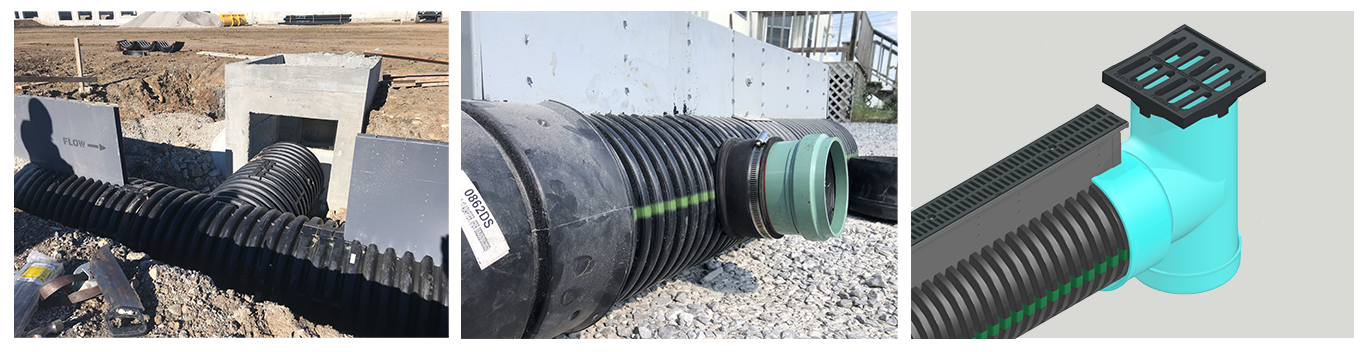
Duraslot® and Duraslot XL are systems engineered to capture and convey built from ADS N-12 HDPE Pipe. As a result, they behave hydraulically like conventional storm pipes supporting large flow rates and long uninterrupted run lengths. Integrated slot risers allow for continuous surface inlet capture along the full length of each run.
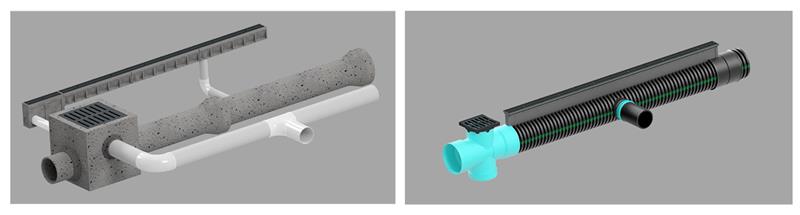
Typical Trench Drain vs. Duraslot Layout
Compared to traditional trench drains, this pipe-first approach simplifies layouts and greatly improves hydraulic performance. In addition, these products convert surface capture directly into conveyance. By shifting control from surface structures to pipe design, additional inflows and connections can consolidate into a single run, improving efficiency and simplifying the overall layout.
This system-level thinking unlocks multiple design advantages:
- Each run can function as the primary trunkline for a drainage area
- Multiple inflows from surface runoff, roof drains, and laterals can enter into a single continuous pipe channel
- The system ties seamlessly into Nyloplast catch basins, Inserta Tee lateral connections, N-12 pipe, and certain sizes of HP Storm pipe products without additional components
- Less transitions and structures are required reducing construction time and easing long-term maintenance
Practical takeaway: Simplify the layout by treating Duraslot designs as both the conveyance pipe as well as an inlet. The more the system flows through one backbone, the cleaner, simpler and more reliable it becomes.
Understand Grading - Plan for Sheet Flow
Grading plays a central role in drainage performance because surface slope determines how runoff reaches the inlet. Linear drains like Duraslot and Duraslot XL are well suited for capturing sheet flow by collecting water continuously along the run, rather than relying on undulating low points. This allows site grading to be simplified into broader, more uniform slopes and reduces the risk of localized ponding. Where additional flexibility is needed, optional custom slot heights allow the surface grade to be set independently of the pipe slope, preserving hydraulic performance without forcing strict pavement design. These capabilities can support the two basic types of design applications: sag conditions and on-grade installations.
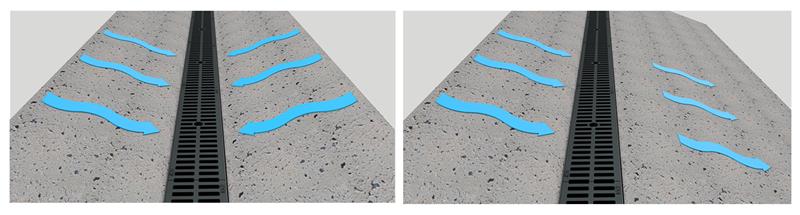 On Grade vs. Sag Condition
Sag conditions occur at a natural or intentional low point. During heavy rain, temporary ponding increases head pressure on the grate, increasing inlet capacity. In these locations, Duraslot XL is the preferred solution because its larger surface opening tolerates debris. This reduces the risk of surface clogging in high-collection zones and prevents standing water.
On-grade installations take place where water is allowed to pass over the grate and continue to a lower elevation during rain events. Openings intercept sheet flow along the length of the run, reducing dependence on isolated surface depressions and allowing smooth, uninterrupted pavement profiles. This configuration is ideal for engineers who want to maintain consistent grading while intercepting runoff early.
Define the Hydraulic Load
Start a strong design by placing a single run of Duraslot or Duraslot XL in the middle or to the side of a broad drainage area. Every drainage network must account for possible inflow sources like sheet flow across the surface, upstream pipe, roof leaders and other lateral connections. All of these inflows can then be integrated directly into the Duraslot run allowing multiple sources to enter a single pipe channel rather than being split across parallel systems. For instance, roof drains and laterals can tie directly into the pipe using Inserta Tee, creating watertight connections without additional structures. Flow from these sources also helps flush the line, improving self-cleaning during storms.
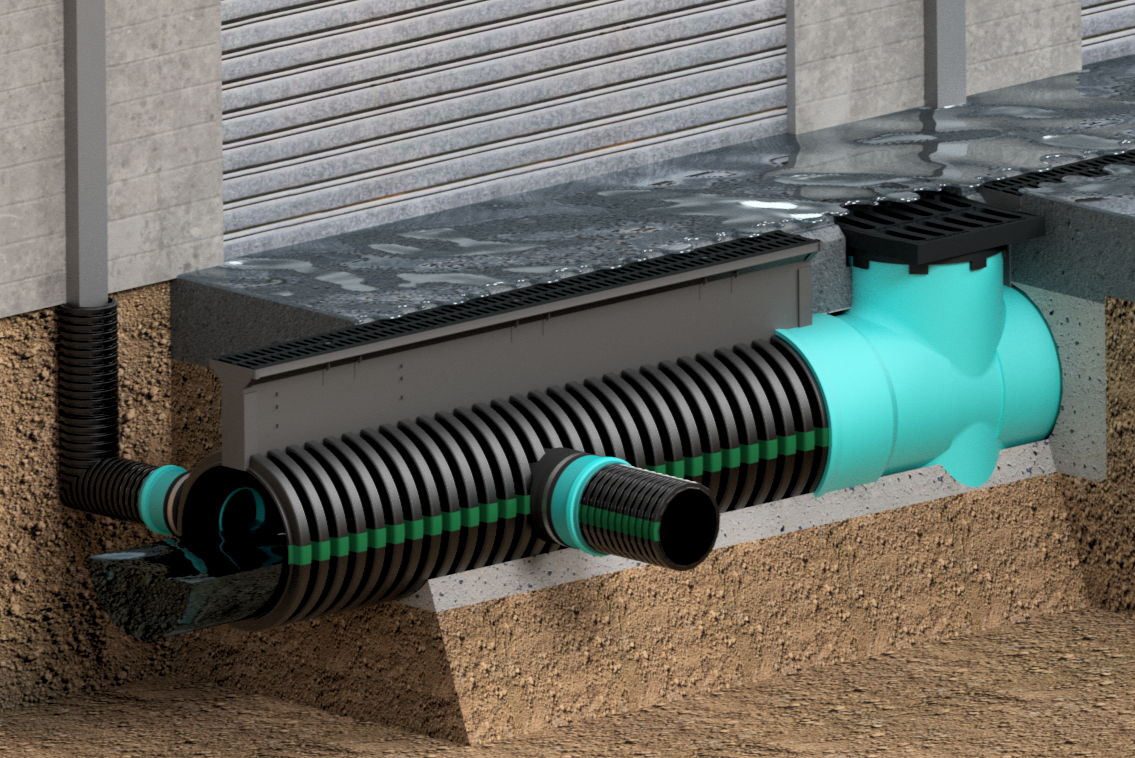 Multiple Inflow Sources Entering the Duraslot Backbone
By merging inflows into one run, engineers:
- Eliminate redundant lateral connections and reduce the number of stormwater structures required
- Simplify hydraulic modeling
- Help systems maintain higher velocities inside a single pipe run
Practical takeaway: Identify inflow sources early and plan to route as many as feasible into the same Duraslot trunkline. This maximizes efficiency and simplifies the network.
Designing the Pipe Channel
Duraslot systems are constructed from smooth wall HDPE pipe and behave similarly. Pipe sizing, therefore, follows familiar practices so Manning’s Equation or Figure 3-1, page 81 from the ADS Drainage Handbook can be used. Typically, engineers start with a design flow rate, but selecting any two of flow rate, pipe diameter, slope or velocity can be used to solve for the remaining variables.
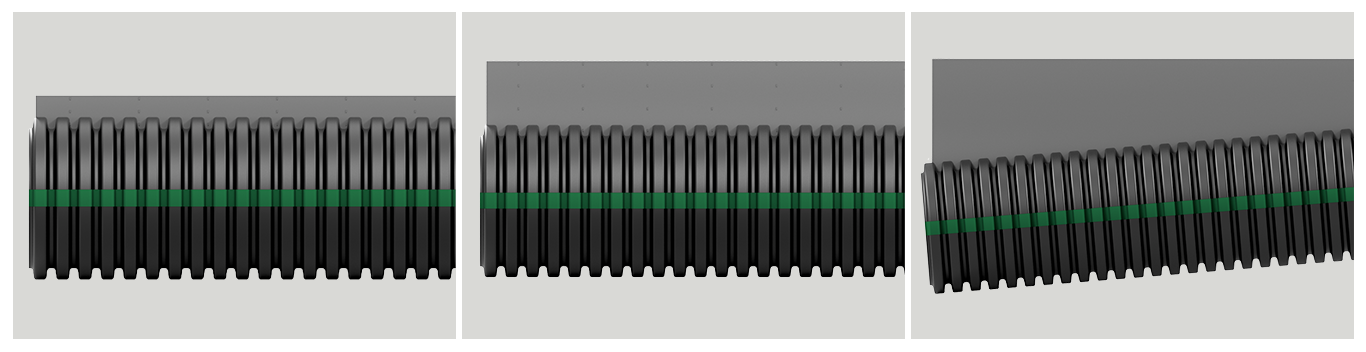
Duraslot products can be fabricated with neutral 2.5-inch or 6-inch slot risers, allowing the channel to follow the surface grade. However, surface grading rarely conforms to that, but these systems do. Slot heights can be customized so that the pipe and grade slope can be set independently for high design flexibility. A minimum pipe slope between 0.5 – 1% is recommended to improve flow rates and reduced build up in the pipe. Steeper slopes may be used where conditions allow, provided the difference between the grade and pipe slope does not exceed 4%.
Practical takeaway: When designing the channel, engineers should account for burial depth limits (see TN 2.11 Duraslot Burial Depth and Backfill Conditions, Tables 1 – 2). As pipe slope increases, allowable run lengths may shorten due to the more rapid increase in slot riser height. In practice, slope selection should be evaluated early in layout development balancing hydraulic performance, surface grading and constructability over the full length of the run.
Checking Inlet Capacity – Selecting a Grate
Inlet capacity is rarely the controlling factor in Duraslot design because the continuous inlet provides substantially more open area than a point inlet. For example, a 15-foot section of open-top Duraslot offers roughly 315 square inches of opening, comparable to a 2-foot by 2-foot inlet and most installations are longer. Design decisions are driven by conveyance capacity and grading, not inlet limitations.
With inlet capacity generally abundant, grate selection becomes more about matching site needs than maximizing capture. Engineers should consider load class requirements, ADA constraints, aesthetic preferences and anticipated debris conditions when choosing a grate design. There are multiple grate profiles and slot riser combinations to align inlet performance with the functional and visual demands of the site.
.png?sfvrsn=6eb2a5cb_1)
When checking inlet capacity, the inlet capacity charts relate capture rate to head depth in sag conditions and to cross slope in on-grade conditions. Developed through controlled testing in conjunction with Utah State University, these charts represent measured intake performance for specific grate and surface configurations. Engineers should use them to compare expected hydraulic load per foot against tested intake rates and confirm inlet performance aligns with the grading strategy established earlier in the design.
Testing under real-world conditions is important to demonstrate how the products really perform. We partnered with Utah State University's hydraulic testing facility to evaluate Duraslot and Duraslot XL's capacity to handle water flow under a variety of scenarios. Individual testing on different grates provides accurate data on inlet capacity and efficiency.
Practical takeaway: On-grade inlet performance is influenced by approach velocity, flow depth and grate geometry, which is more difficult to model than a sag condition. Use the inlet capacity data as guidance rather than a guarantee, with engineers evaluating how closely their site conditions align with the tested scenario and applying engineering judgment where conditions differ.
Plan for Maintenance and Longevity
Good hydraulic design is the foundation of a low maintenance system and is dictated in part by the channel. Self-cleaning velocity is commonly considered to be between 2.0 – 3.3 ft/s and requires ~2% slope for smaller diameter pipe to promote self-cleaning velocity. These conditions keep pipe flushed, reduce sediment and extend maintenance intervals. Duraslot ensures self-cleaning flow velocity even in neutral grades with slopes up to 4% on a neutral grade.
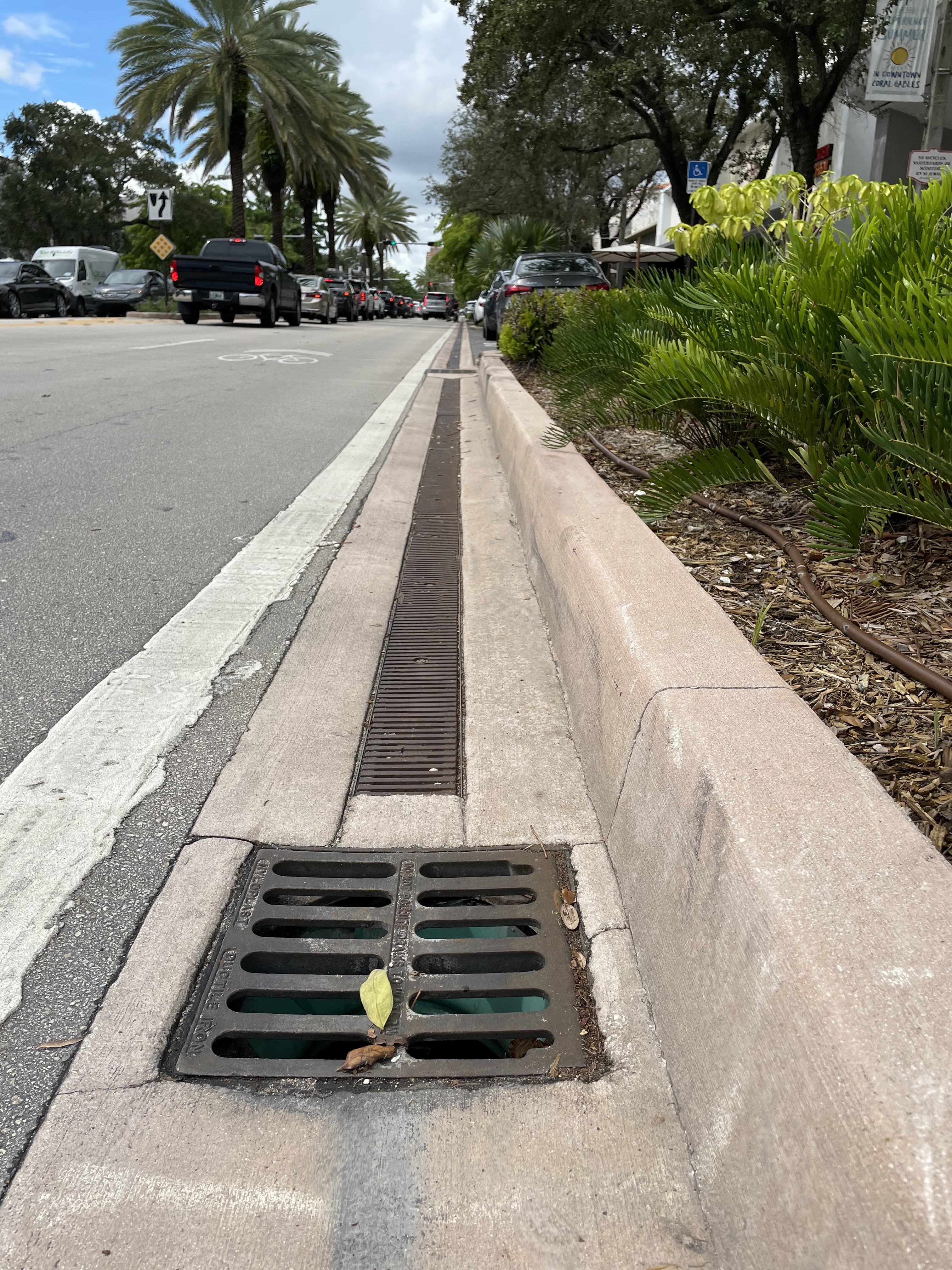 Duraslot Cleanouts for Road & Highway Design
Cleanout points remain important for linear drain maintenance regardless of the design and should be placed every 50 to 100-feet, depending on site conditions and expected loading. Nyloplast structures are well suited for this role, providing a durable solution for easy access into the system. These access points allow routine jetting or inspection and are especially valuable on longer or flatter runs where flow velocities may naturally be lower.
Surface debris is another practical consideration in long-term performance. In environments with heavy foliage or debris, a clogging factor of up to 50% is recommended when evaluating inlet capacity and selecting wider grate options, such as Duraslot XL grates, to better resist blockage and maintain surface intake even when partially covered. For more information on maintenance, the Duraslot and Duraslot XL Maintenance Guide has useful guidelines for system upkeep.
Practical takeaway: Design the system to maintain self-cleaning velocities, space cleanouts strategically, and select grate widths appropriate for debris loads. This ensures reliable long-term performance with fewer maintenance intervals.
Let Linear Drainage Systems Work for you
A Duraslot system unifies surface capture, subsurface conveyance and connectivity into a single, pipe-driven design. Its defining advantage is flexibility within that system: slot heights, pipe diameters, slopes, grate configurations and surface conditions can be adjusted independently without fragmenting the drainage network. This allows the system to respond to real grading constraints, hydraulic demands and maintenance goals rather than forcing the site to conform to a fixed layout.
Used as the drainage backbone, Duraslot shifts design control from surface inlets to pipe design. This reduces transitions, cuts the number of structures needed, simplifies grading, and makes hydraulic behavior easier to model and verify. Because it integrates directly with the broader ADS product family, engineers can deliver a coordinated stormwater system that is adaptable, predictable, and easier to maintain over its full service life.
Let the Duraslot system work for you by:
- Designing a single pipe-driven trunkline that consolidates surface runoff, roof drains, and other laterals
- Using standard pipe hydraulics to model the system with confidence
- Creating self-cleaning velocities through higher continuous flow rates
- Simplifying grading by intercepting sheet flow along the run instead of creating isolated depressions
- Setting surface grade and pipe slope independently using adjustable slot risers
- Selecting grates based on loading, debris, and site constraints rather than inlet capacity limits
- Integrating cleanouts, laterals, and structures into one coordinated ADS system
Projects that benefit from a unified drainage backbone can leverage ADS technical support and the full suite of Duraslot engineering resources. Local representatives are available to provide project-specific guidance, evaluate custom riser configurations, and review layout considerations.