PRODUCTS USED
- 720’ (122 m) of 18” (450 mm) HP Storm HP Storm Dual Wall Pipe
- 740’ (640 m) of 24” (600 mm) HP Storm Dual Wall Pipe
- 380' (98 m) of 30” (750 mm) HP Storm Dual Wall Pipe
- 380' (317 m) of 36” (900 mm) HP Storm Dual Wall Pipe
- 1,420' (140 m) of 42” (1,050 mm) HP Storm Dual Wall Pipe
Although Advanced Drainage Systems (ADS) representatives had presented the advantages of using HP Storm polypropylene pipe, including faster installation and easier material handling, the city initially specified Class III reinforced concrete pipe (RCP) for the 18th Street Capital Improvement Project.
Midway through the installation, Port Arthur realized the project would not be complete on time because of delays receiving RCP and the time-consuming installation process required for RCP.
SOLUTION
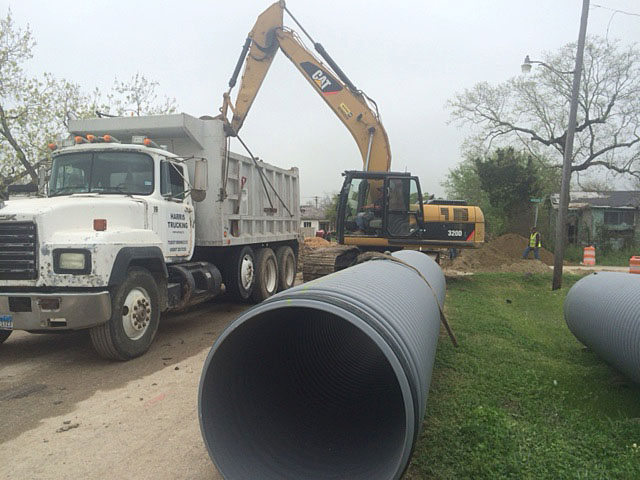
To keep the project on schedule, the contractor, McKinnis Construction, and the city engineer made the decision to transition to HP Storm. The impact was immediate. HP Storm was readily available and its lightweight design allowed crews to handle and install pipe more efficiently, doubling the installation speed compared to reinforced concrete pipe. As a result, McKinnis Construction completed the project ahead of schedule while achieving measurable installation cost savings, much to the city’s satisfaction. This marked the first use of HP Storm in Port Arthur, delivering not only construction efficiencies but also long-term performance benefits, including watertight joints and superior pipe stiffness.
PRODUCT DESCRIPTION
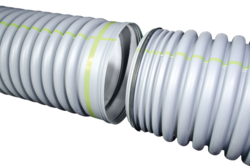
HP Storm polypropylene pipe provides superior pipe stiffness, longer bells and spigots and a premium joint performance for a longer service life. The smooth interior wall offers additional strength and high flow capacity. HP Storm pipe meets or exceeds the standards specified in ASTM F2881 and AASHTO M330 and the extended bell and spigot meets ASTM D3212. Polypropylene is resistant to the effects of chemicals, abrasion, hot soils and effluent.